It’s January, the month of ‘New Me’s’, ‘New Resolutions’ and ‘New Beginnings’ which all encompass the big theme of ‘change’. But rather than thinking about personal change, we should start thinking about global change, and yes I hear the eye roles, but I feel we can take some of our newly developed behaviours from last year into this year.
Now you might be thinking, umm what? Why would we want to continue on with how things worked last year? But one thing that has become clear thanks to the coronavirus Pandemic starting last year and continuing this year for many countries, was that in order to survive, we need to be adaptable.
March in 2020 looked at lot different than many of us expected. Some of the most noticeable changes came from supermarkets. Firstly, people stockpiled everything, which then lead us to the inevitable second observation: items quickly became unavailable and out of stock.
Let’s first explain point 1: The Psychology behind Consumer Stockpiling!
How did we end up in a situation where toilet roll became the new currency. It didn’t take very long before it felt like you’d have to go on the black market to get a couple of rolls. Even my mum rang me at the beginning of March to warn me to get some toilet roll:
Me: “I’m fine I still have a packet, I don’t need to go out to get any”
Mum: “Yes but your father went to the shops the other day and things are getting low in stock”
Me: “Mum I’m fine don’t worry I won’t be out of any loo rolls”
Mum: “Well we have some I can send it up in the post”
Me: “aha don’t be silly I think I’ll be fine”
…. a few weeks and a trip to the supermarket later, I sadly admitted that my mum was right and there I stood looking at the empty shelves where loo roll once stood. But as most students know, we are always adaptable and after some brief negotiations with my roommate, a tub of hummus was exchanged for one loo roll and all was good.
So what happened? Why was there this sudden appearance of empty shelves and lack of common goods. Consumers stockpiling can be explained through the ‘Commodity Theory’. This theory proposes that the value of a product is positively related to its scarcity, thus the idea that when you can’t get an item ‘you want it more’, stimulating stockpiling behaviour.
Consumer stockpiling can also be explained using ‘Prospect Theory’, this is a theory of decision making which attempts to explain how peoples decisions are influenced by their attitude towards risk, uncertainty, loss and gain. The theory suggests that people are unable to accurately evaluate probabilities correctly and are largely motivated by a strong fear of loss. In order to avoid potential losses in the face of uncertainty, we inevitability end up in a situation where consumer’s stockpile (well, more like hoard) essential items.
Now how does that affect point 2: Consequences of Consumer Stockpiling!
Consumer stockpiling has immediate affects on retailers, but unlike more predictable environmental emergencies, the coronavirus pandemic led to widespread shortages, which left the supermarkets scarce of many things, not just toilet roll. Another product which was noticeably sparse was flour. Now if you got into the avid baking phase of lockdown you’d know that finding that last, elusive bag of flour gave you that same exciting rush that gold miners must feel when they find a nugget.
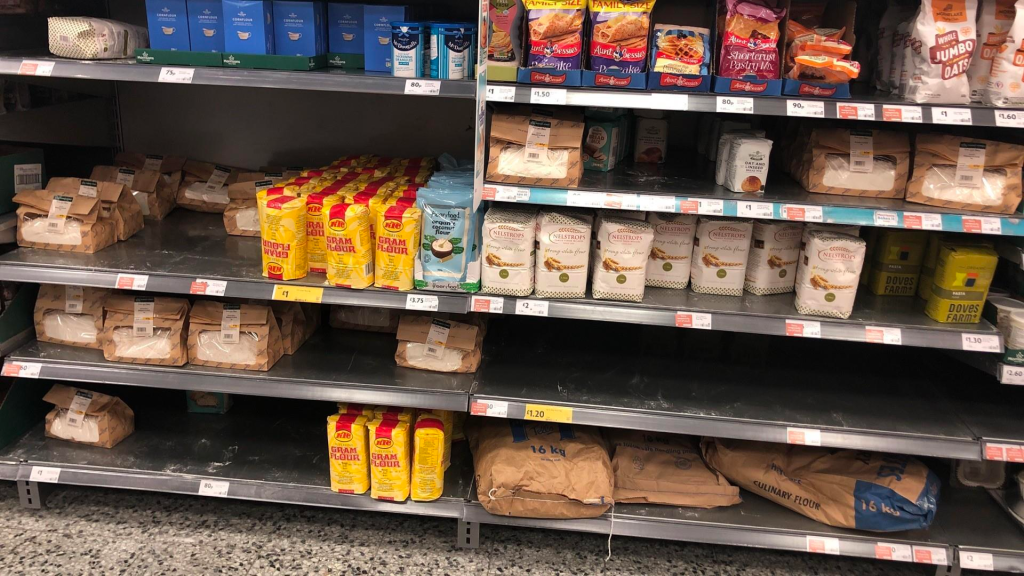
But on a hopeful note, we as a society adapted, and supermarkets soon began packaging up their flour in nonstandard packaging, with one retailer using the packaging that they use for doughnuts. This may seem odd to be hopefully about, but this small introduction allows the idea that people will adapt to new ways of experiencing their shopping. By supermarkets selling their own, …..it shows that they can adapt when pushed, and it is likely that this small change of using their own packaging will have a knock in effect of helping reduce the excess packaging.







 Wobbins